

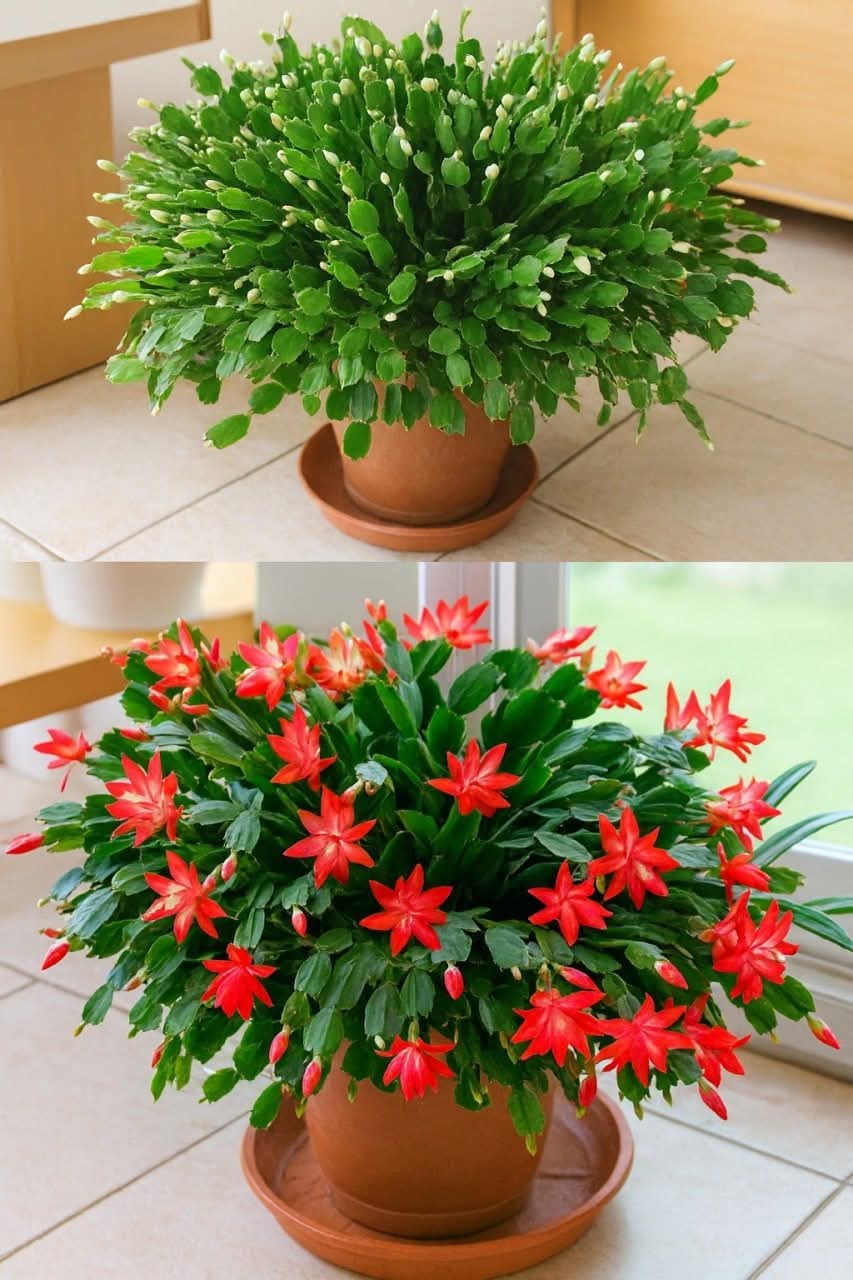
Forget everything you think you know about cacti. Your Christmas cactus isn’t a desert dweller—it’s a rainforest epiphyte that craves humidity, dappled light, and a little strategic neglect. Master its secrets, and it will reward you with decades of spectacular blooms.
There’s something almost magical about a Christmas cactus in full flower. While winter settles in outside, this unassuming plant explodes with cascades of jewel-toned blossoms—magenta, pink, white, even bi-colored—that seem to defy the season . But here’s the truth: getting those blooms isn’t about luck. It’s about understanding the quiet, specific language of this remarkable plant.
A well-cared-for Christmas cactus (Schlumbergera × buckleyi) isn’t just a holiday decoration. It’s a living heirloom that can thrive for 100 years or more, passed down through generations . And while “blooming all year long” isn’t botanically accurate—these plants need rest periods—you can achieve two spectacular flowering cycles annually with the right care, plus keep the plant lush and vibrant even when it’s not in flower .
This guide distills expert advice from university extension services, master gardeners, and botanical institutions into one comprehensive, no-fluff roadmap. Whether you’re a first-time owner or a seasoned enthusiast, here’s exactly how to make your Christmas cactus thrive—and bloom—like never before.
🌿 Part I: Know Your Plant (Species Matters!)
Before we dive into care, you need to identify your cactus. Many “Christmas cacti” sold today are actually Thanksgiving cacti (Schlumbergera truncata), which have sharp, claw-like stem projections. A true Christmas cactus (Schlumbergera × buckleyi) has rounded, scalloped edges on its stems .
Why it matters: Their care is nearly identical, but bloom time differs. Thanksgiving cacti flower earlier (November), while true Christmas cacti peak in December-January . This guide covers both—the principles are the same.
Quick ID: Run your finger along a stem segment edge. Pointy = Thanksgiving. Rounded = Christmas .
☀️ Part II: Light – The Goldilocks Principle
Christmas cacti are understory rainforest plants. They do not want full sun. They do not want deep shade. They want bright, indirect light—the kind that filters through a sheer curtain or comes from an east-facing window .
Optimal placement:
· East or north-facing windows are ideal .
· West or south windows work only if you filter the light with blinds or sheer curtains.
· Too much sun: Leaves turn yellow, bleached, or red .
· Too little sun: Plant becomes leggy, pale, and refuses to bloom .
Pro tip: Rotate your plant regularly during the growing season so all sides receive even light .
💧 Part III: Watering – The Art of Subtle Stress
This is where most owners go wrong. Your Christmas cactus wants consistent moisture, not soggy feet—and it absolutely cannot sit in standing water .
The Golden Rule: Water when the top 1-2 inches of soil feel dry . For most homes, this means:
· Growing season (spring-fall): Water approximately once weekly .
· Dormancy/rest periods: Water sparingly—every 3-4 weeks or when leaves just begin to pucker .
Critical warnings:
· Overwatering = root rot = mushy stems, foul smell, plant death .
· Underwatering = shriveled, limp segments (but plant usually recovers).
· Always use lukewarm water—cold water shocks the roots .
· Ensure pots have drainage holes. This is non-negotiable.
🌱 Part IV: Soil & Repotting – Roots Like to Be Cozy
Soil Mix:
Christmas cacti need coarse, fast-draining, slightly acidic soil. Standard potting soil is too dense and retains too much water .
The Perfect Recipe (recommended by the Cactus and Succulent Society of New Mexico):
· 2 parts peat moss
· 1 part packaged potting soil
· 1 part sharp sand or perlite
Alternative: Use a commercial cactus/succulent mix or orchid mix . Adding extra perlite is always a good idea.
Repotting Schedule:
Unlike most houseplants, Christmas cacti bloom best when slightly pot-bound. Do not repot annually .
· Repot every 3-4 years, or when you see:
· Roots growing through drainage holes
· Stunted growth despite good care
· Water runs straight through (soil is depleted)
When: Late winter or early spring (March), immediately after flowering and before new growth begins .
Pot size: Increase by only 1-2 inches in diameter. Too-large pots retain excess moisture and delay blooming . Terracotta pots are excellent—they wick away extra moisture .
🌡️ Part V: Temperature & Humidity – The Rainforest Effect
Temperature:
This plant thrives at what you thrive at: 60-80°F (15-27°C) .
· Growing season: 70-80°F day, 50-65°F night .
· To initiate blooms: Cool nights (50-65°F) are essential. This is the secret sauce .
Absolute no-nos:
· Do not place near radiators, HVAC vents, or fireplaces .
· Do not expose to drafts or sudden temperature swings—buds will drop instantly .
· Do not let temperatures exceed 90°F—buds abort .
Humidity:
These are rainforest plants. They crave humidity .
· Ideal: 50-60% humidity.
· Solutions: Misting (2-3 times weekly), pebble trays with water, grouping plants together, or placing in a bright bathroom .
· Low humidity warning: Buds may shrivel and drop; leaves may look dull.
🌸 Part VI: Fertilization – Feed the Beast, But Know When to Stop
When to fertilize: Only during active growth (March/April through August/September) .
What to use:
· Balanced, water-soluble fertilizer (10-10-10 or 20-20-20) .
· Dilute to half-strength—strong fertilizer burns roots .
Schedule:
· Every 2-4 weeks during growing season .
· Stop completely by late August/September—this signals the plant to prepare for blooming .
· No fertilizer during winter dormancy or rest periods .
✂️ Part VII: Pruning & Shaping – The Secret to More Blooms
Pruning isn’t just about aesthetics—it directly increases future flowers.
When to prune: Immediately after flowering ends (January-March) .
How to prune:
· Use sterile, sharp scissors or pruning shears.
· Cut at the joints between segments .
· Remove 2-4 segments per stem to encourage branching.
· Also remove dead, damaged, or leggy growth at the base .
Why it works: Each new branch creates more potential flowering sites for next season. A pruned plant = a fuller, more floriferous plant .
Don’t forget to deadhead: Remove spent flowers promptly. It redirects energy to new growth .
🔄 Part VIII: Propagation – Free Plants!
Christmas cacti are absurdly easy to propagate. One plant can become dozens.
Step-by-step:
In spring or early summer, twist off segments with 3-5 leaf sections .
Let cuttings dry for 1-2 days—this calluses the end and prevents rot .
(Optional) Dip in rooting hormone—speeds success but not required .
Insert 1cm deep into moist perlite/peat mix or cactus soil .
Place in bright, indirect light. Water sparingly.
Roots appear in 3-8 weeks. You’ll know it worked when the cutting resists a gentle tug .
Pro tip: Propagated plants make incredible, meaningful holiday gifts .
🕯️ Part IX: The Blooming Formula – How to Get Flowers on Command
This is what you came for. Here’s the science-backed protocol to trigger flowering—every single time.
Christmas cacti are photoperiodic. They bloom in response to long nights and cool temperatures. You must replicate these conditions .
Option A: The Cool Night Method (Easier)
If you can keep your plant in a room with night temperatures of 50-55°F (10-13°C) starting in mid-September, buds will form naturally—no darkness manipulation needed .
Option B: The Darkness Method (Foolproof)
Starting mid-September to early October:
Provide 13-14 hours of COMPLETE, UNINTERRUPTED DARKNESS every night .
During the day, give 8-10 hours of bright, indirect light .
Stop fertilizing .
Reduce watering—keep soil barely moist .
How to achieve darkness:
· Place plant in a closet or unused room where lights are never turned on.
· Cover with a black cloth, cardboard box, or large paper bag .
· Crucial: No peeking! Even brief light exposure can interrupt bud formation.
Duration: Continue this regimen for 6-8 weeks . Buds should appear within 4-6 weeks. Once buds are visible, move plant back to its regular spot and resume normal watering. Do not move or rotate once buds form—they will drop .
🗓️ Part X: Year-Round Care Calendar
Here’s your at-a-glance seasonal roadmap, synthesized from expert sources .
Season Light Water Fertilizer Temp Special Tasks
Winter (Dec-Feb) Bright, indirect When top 2″ dry None Cool (55-65°F) ENJOY BLOOMS! Deadhead spent flowers.
Late Winter (Feb-Mar) Bright, indirect Reduce slightly None (rest) Cool (50-55°F) Prune, repot, propagate. 4-6 week rest.
Spring (Mar-May) Bright, indirect Regular (1x/week) Begin monthly half-strength 60-70°F Move to brighter spot. Resume watering.
Summer (Jun-Aug) Bright, indirect Regular; watch for drying Continue monthly 60-70°F Can move outdoors to shaded patio. Mist for humidity.
Early Fall (Sep-Oct) 13-14h DARKNESS Reduce STOP Cool (50-60°F nights) Bud initiation period. 6-8 weeks.
Late Fall (Nov-Dec) Bright, indirect Normal None Cool-moderate Buds swell. DO NOT MOVE.
🆘 Part XI: Troubleshooting – What’s Wrong With My Plant?
❌ No flowers / Won’t bloom
· Cause: Not enough autumn darkness; nights too warm; fertilized too late .
· Fix: Strict 13-14 hour darkness for 6-8 weeks; ensure cool nights (50-65°F).
❌ Buds dropping
· Cause: Plant moved; temperature fluctuations; drafts; over/under-watering; low humidity .
· Fix: Once buds appear, do not move the plant. Stabilize environment.
❌ Limp, mushy stems
· Cause: Overwatering / root rot. This is the #1 killer .
· Fix: Stop watering. Remove from pot, trim rotten roots, repot in fresh dry soil. Water sparingly.
❌ Wrinkled, shriveled leaves
· Cause: Underwatering or root damage .
· Fix: Soak thoroughly and adjust watering schedule.
❌ Red or purple leaves
· Cause: Too much direct sun; phosphorus deficiency; cold stress .
· Fix: Move to filtered light.
❌ Yellow leaves
· Cause: Too much sun; root rot; nutrient deficiency .
· Fix: Assess light and watering.
❌ White, fluffy blobs on stems
· Cause: Mealybugs .
· Fix: Wipe with alcohol-soaked cotton swab; spray with insecticidal soap.
❌ Fine webbing / stippled leaves
· Cause: Spider mites .
· Fix: Increase humidity; rinse plant; use miticide if severe.
❌ Plant is top-heavy / leaning
· Cause: Natural growth habit. They trail .
· Fix: Prune back long stems; consider hanging basket.
💚 Part XII: The Big Picture – Why This Plant Matters
A thriving Christmas cactus isn’t just a houseplant. It’s a connection—to nature’s rhythms, to patient care, to the generations who grew these plants before us. These succulents have been passed down in families for over a century, their blooms marking the holidays like clockwork .
The care isn’t complicated. It’s simply respectful. Respect for where it comes from (the misty Brazilian cloud forests). Respect for its cycles (growth, rest, bloom). Respect for its limits (no soggy roots, no scorching sun).
Do these things—the right light, the right soil, the strategic darkness, the patient dormancy—and your Christmas cactus won’t just survive. It will thrive. It will become one of those plants friends ask about, family members request cuttings of, and you yourself will marvel at, year after year.
Now, we’d love to hear from you. What’s your Christmas cactus success story? A 50-year-old heirloom? A dramatic recovery? Your first bloom? Share your photos and tag us. And for more plant care deep dives and gardening wisdom, explore the blog.
P.S. Do not lose this guide! Pin it, bookmark it, save it now. This is the reference you’ll come back to every September when it’s time to start those long, dark nights—and every January when you’re pruning for next year’s show. Your Christmas cactus is counting on you.
More Recipes You Might Like
-

Crock Pot Chicken And Noodles Belongs
The Ultimate Comfort: Why 4-Ingredient Crock Pot Chicken And Noodles Belongs in Your Weekly Rotation There is a specific, almost…
-

Carrot Cake Roll with Cream Cheese Frosting
The Swirl of Perfection: Why Carrot Cake Roll with Cream Cheese Frosting Is the Dessert That Steals the Show There…
-

LOADED CHEESY POCKET TACOS
The Handheld Fiesta: Why Loaded Cheesy Pocket Tacos Are the Dinner Revolution You Need There is a specific, almost primal…