

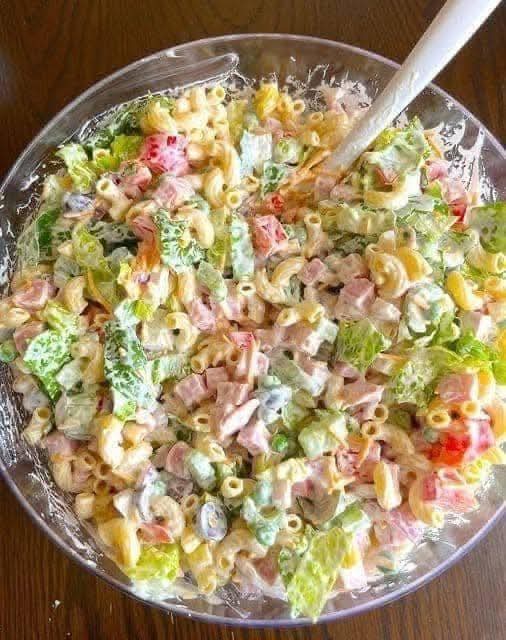
There is a specific, almost reverent hush that falls over a potluck table when the right dish appears. It is not the fanciest dish. It is not the most expensive dish. It is the dish that looks like someone cared enough to make something beautiful.
The layered pasta salad is that dish.
It arrives in a clear glass bowl, its strata visible like geological history—a foundation of creamy dressing, a layer of tender pasta, a ribbon of vibrant vegetables, a snowfall of cheese, a final flourish of fresh herbs. It is edible art. It is architecture you can eat. It is the dish that makes people reach for their phones before they reach for a plate.
But layered pasta salad is not just a pretty face. Beneath that beautiful exterior lies a perfectly engineered potluck solution. The layers serve a purpose. The dressing stays at the bottom, gradually permeating upward as the salad rests, ensuring every bite is perfectly seasoned without anything becoming soggy. The sturdy vegetables provide structural support. The tender ingredients stay near the top, added just before serving.
It is form following function. It is beauty with brains. It is the salad that thinks it’s a centerpiece.
If you are searching for stunning potluck salads that feed a crowd, or if you need make-ahead pasta dishes that travel beautifully, this layered pasta salad is your answer. It is the dish that will have people asking for the recipe before they finish their first serving. It is the salad that earns its place in the rotation.
The History of Layered Salads
Layered salads emerged in mid-century America, alongside Jell-O molds and casseroles and all the other creative constructions of the 1950s and 60s. They were born of the same impulse that produced seven-layer dip and trifle: the desire to create something visually impressive from simple ingredients.
The first layered salads were often made with lettuce, peas, celery, and onions, layered with mayonnaise-based dressing in a glass bowl. The most famous is the “seven-layer salad,” which typically includes lettuce, peas, bacon, cheese, and dressing, all arranged in striated glory.
Pasta salads joined the layered family later, as cooks realized that the same principle could apply to any combination of ingredients. The glass bowl became the canvas. The layers became the art.
Today, layered pasta salad is a potluck classic, beloved for its visual appeal and its practical advantages. It is the dish that looks like you spent hours, even though the layering takes minutes.
The Anatomy of the Perfect Layered Pasta Salad
Great layered pasta salad has seven essential components, each playing a specific role.
The Bottom Layer: Dressing
Always at the bottom. This is the foundation. As the salad rests, the dressing gradually permeates upward, seasoning every layer without making anything soggy. Use enough dressing to create a visible pool at the bottom—about 1 ½ cups for a 9×13 dish.
The Second Layer: Sturdy Pasta
Immediately atop the dressing. The pasta acts as a sponge, absorbing the dressing while maintaining its shape. Choose a pasta shape with plenty of crevices to catch and hold dressing. Rotini, fusilli, and farfalle are excellent choices.
The Third Layer: Hard Vegetables
Broccoli, carrots, bell peppers, cucumbers. These sturdy vegetables can withstand contact with dressing without becoming limp. They provide crunch and color.
The Fourth Layer: Cheese
A middle layer of cheese adds richness and protein. Shredded cheddar, mozzarella pearls, or crumbled feta all work beautifully.
The Fifth Layer: Protein
Diced ham, salami, chicken, or pepperoni. This layer adds substance and makes the salad a meal.
The Sixth Layer: Tender Vegetables
Cherry tomatoes, avocado, fresh herbs. These delicate ingredients go near the top, added just before serving to prevent them from becoming mushy or discolored.
The Seventh Layer: Garnish
The final flourish—fresh parsley, basil, a shower of Parmesan, a scattering of olives. This is the promise of what lies beneath.
The Ultimate Layered Pasta Salad Recipe
Yield: 12-16 servings
Ingredients:
For the Dressing:
· 1 ½ cups mayonnaise
· ½ cup sour cream
· ¼ cup red wine vinegar
· 2 tablespoons lemon juice
· 2 cloves garlic, minced
· 1 tablespoon Dijon mustard
· 1 teaspoon sugar
· 1 teaspoon kosher salt
· ½ teaspoon black pepper
· ½ cup grated Parmesan cheese
· ¼ cup fresh parsley, finely chopped
For the Salad:
· 1 lb rotini or fusilli pasta
· 2 cups broccoli florets, cut into bite-sized pieces
· 1 ½ cups diced English cucumber (seeds removed)
· 1 cup diced red bell pepper
· 1 cup diced orange or yellow bell pepper
· ½ cup finely diced red onion
· 2 cups shredded sharp cheddar cheese
· 8 oz diced ham or salami (or a combination)
· 1 pint cherry tomatoes, halved
· 1 can (6 oz) black olives, drained and sliced
· ½ cup fresh basil, chiffonade
For the Garnish:
· Additional Parmesan cheese
· Fresh parsley or basil
· Cracked black pepper
Instructions:
Phase One: The Dressing
Combine: In a medium bowl or large measuring cup, whisk together the mayonnaise, sour cream, red wine vinegar, lemon juice, garlic, Dijon, sugar, salt, and pepper until smooth and emulsified.
Finish: Stir in the grated Parmesan and fresh parsley. Taste and adjust seasoning. Refrigerate while you prepare the remaining ingredients.
Phase Two: The Pasta
Boil: Bring a large pot of generously salted water to a rolling boil. Add the pasta and cook according to package directions until al dente. Do not overcook.
Drain and Rinse: Drain the pasta in a colander and rinse immediately with cold water to stop the cooking process. Shake vigorously to remove excess water. Spread the pasta on a baking sheet in a single layer to cool completely and dry slightly. This prevents clumping and diluting the dressing.
Phase Three: The Vegetables
Prep: Prepare all vegetables as specified. Keep them separate. Pat the cherry tomato halves gently with a paper towel to remove excess seeds and juice.
Salt the Broccoli (Optional): If you have time, toss the broccoli with a pinch of salt and let it sit for 15 minutes. This draws out excess moisture, which you can then blot away.
Phase Four: The Assembly
Choose Your Vessel: Select a large, clear glass bowl. A trifle bowl is ideal. A large glass mixing bowl works beautifully. The bowl must be transparent.
The Dressing Foundation: Spread the prepared dressing evenly across the bottom of the bowl. Use an offset spatula or the back of a spoon to create an even layer reaching to the edges.
The Pasta Layer: Gently place the cooled pasta over the dressing. Spread evenly to the edges. Do not press down.
The Broccoli and Pepper Layer: Arrange the broccoli florets and diced bell peppers evenly over the pasta. Press gently to create a flat surface.
The Onion and Cucumber Layer: Sprinkle the diced cucumber and red onion over the vegetables. Spread evenly.
The Cheese Layer: Sprinkle the shredded cheddar cheese over the cucumber and onion.
The Protein Layer: Scatter the diced ham or salami over the cheese.
The Tomato and Olive Layer: Arrange the cherry tomato halves and sliced black olives over the protein.
The Herb Finish: Sprinkle the fresh basil chiffonade over the tomatoes and olives.
The Garnish: Finish with a final shower of Parmesan, additional fresh herbs, and a generous crack of black pepper.
Phase Five: The Rest
Cover: Cover the bowl tightly with plastic wrap. Refrigerate for at least 4 hours, preferably overnight. This resting period is non-negotiable. The dressing permeates upward, the flavors meld, and the salad transforms from ingredients into a cohesive dish.
Serve: Remove from the refrigerator 20 minutes before serving. Toss the salad at the table, or allow guests to scoop from the bottom, creating their own perfect mixture of layers. Provide a large serving spoon and fork.
The Pasta Selection Seminar
Not all pasta shapes are suitable for layered salad. The shape must capture and hold dressing, maintain its texture after chilling, and provide structural integrity.
Rotini or Fusilli: The gold standard. The spirals trap dressing in their crevices. They hold their shape beautifully.
Farfalle: Bow ties are elegant and substantial. They create distinct visual layers.
Shells: Medium shells capture dressing and small vegetable pieces in their cups. Whimsical and effective.
Penne or Ziti: Tubular shapes work but require careful draining. Water trapped inside tubes dilutes dressing.
Orzo: Too small. It settles into a dense, compacted layer.
The Dressing Spectrum
The creamy garlic Parmesan dressing in the master recipe is canonical. But layered pasta salad welcomes variety.
Classic Italian Vinaigrette: ¾ cup olive oil, ¼ cup red wine vinegar, 2 tablespoons lemon juice, 1 tablespoon Dijon, 2 cloves garlic, 1 teaspoon dried oregano, salt, pepper.
Creamy Balsamic: 1 cup mayonnaise, ¼ cup balsamic vinegar, 2 tablespoons honey, 1 clove garlic, salt, pepper.
Lemon Herb: 1 cup Greek yogurt, ½ cup mayonnaise, ¼ cup lemon juice, 2 tablespoons olive oil, ¼ cup fresh dill and parsley, 2 cloves garlic, salt, pepper.
Ranch: 1 cup mayonnaise, ½ cup sour cream, ¼ cup buttermilk, 1 packet ranch seasoning, 2 tablespoons fresh dill.
Spicy Chipotle: 1 cup mayonnaise, ¼ cup lime juice, 2 tablespoons adobo sauce, 1 minced chipotle, 1 clove garlic, 1 teaspoon honey, salt.
The Flavor Universe: Infinite Layered Variations
The master recipe is a template. Here are seven distinct variations.
Italian Antipasto Layered Pasta Salad:
Use Italian dressing. Layer with salami, pepperoni, provolone cheese, marinated artichoke hearts, roasted red peppers, and pepperoncini. Garnish with fresh basil and oregano.
Greek Layered Pasta Salad:
Use lemon herb dressing. Layer with feta cheese, kalamata olives, cucumber, red onion, bell peppers, and cherry tomatoes. Garnish with fresh dill and oregano.
Southwest Layered Pasta Salad:
Use chipotle ranch dressing. Layer with black beans, corn, pepper jack cheese, diced chicken or chorizo, bell peppers, and red onion. Garnish with cilantro and crushed tortilla chips.
Caprese Layered Pasta Salad:
Use balsamic vinaigrette. Layer with fresh mozzarella pearls, cherry tomatoes, and fresh basil. Omit the heartier vegetables. This is summer on a plate.
Caesar Layered Pasta Salad:
Use Caesar dressing. Layer with romaine lettuce (near the top), shaved Parmesan, croutons (added just before serving), and grilled chicken. This is Caesar salad, deconstructed.
Mediterranean Chicken Layered Pasta Salad:
Use lemon herb dressing. Layer with shredded rotisserie chicken, feta, kalamata olives, cucumber, red onion, and sun-dried tomatoes. This is a complete meal.
BLT Layered Pasta Salad:
Use buttermilk ranch dressing. Layer with crisp romaine lettuce (near the top), cherry tomatoes, and crumbled bacon. Add diced avocado if desired. Garnish with fresh chives.
The Glass Bowl Selection
The vessel matters. Here is how to choose.
Trifle Bowl: The ideal. Tall, straight sides, completely transparent. Designed specifically for displaying layered creations. Usually 3-4 quarts capacity.
Glass Mixing Bowl: Excellent. Slightly curved sides, which affect the visibility of layers but create a beautiful overall presentation. At least 3 quarts.
Square Glass Baking Dish: Surprisingly effective. Creates a rectangular layered salad that slices like lasagna. Unconventional but stunning.
Mason Jar Individual Servings: For picnics and portion control. Layer ingredients in wide-mouth pint jars. Perfect for grab-and-go lunches. Dress at the bottom, pasta, vegetables, cheese, protein, garnish. Shake to dress before eating.
The Make-Ahead Advantage
Layered pasta salad is not merely tolerant of advance preparation; it requires it.
Four Hours: Minimum resting time. The dressing has begun to penetrate the pasta but has not fully permeated the upper layers.
Overnight: Optimal. The flavors meld completely. The pasta absorbs dressing evenly. The vegetables remain crisp but seasoned.
Twenty-Four Hours: Still excellent. The vegetables may soften slightly, but the overall effect remains delicious.
The Serving Temperature Question
Layered pasta salad should be served cold but not frigid.
Too Cold: Refrigerator-temperature salad numbs the palate. The dressing thickens. The pasta stiffens.
Too Warm: The dressing thins. The vegetables soften. The salad becomes limp.
Ideal: Remove from the refrigerator 20-30 minutes before serving. The salad should be cool but not icy. The dressing loosens slightly. The flavors open up.
The Toss Timing
Layered pasta salad presents a philosophical dilemma: to toss or not to toss?
The Traditionalist Approach: Toss at the table. Use two large spoons to gently lift and fold the layers together. This creates a unified salad and distributes the dressing evenly. It also destroys the beautiful layers, which is the point—the reveal of chaos from order.
The Individualist Approach: Do not toss. Allow guests to scoop from the bottom, drawing up dressing and layers in each serving. This preserves the visual spectacle throughout the meal.
The Compromise: Toss the bottom half of the salad, leaving the top layers intact. This provides both drama and even distribution.
Troubleshooting: When Salads Go Wrong
The Salad Is Watery: You did not dry your ingredients sufficiently. Next time, dry the pasta thoroughly, salt the vegetables, and seed the tomatoes.
The Dressing Is Too Thick: Add a tablespoon of milk or vinegar and whisk until smooth.
The Dressing Is Too Thin: Add more mayonnaise or sour cream, or let the salad chill longer.
The Pasta Is Mushy: You overcooked it. Next time, cook to al dente and rinse immediately.
The Layers Collapsed: You pressed too firmly during assembly. Next time, arrange layers gently.
The Tomatoes Leaked: You did not seed them, or you added them too early. Next time, seed thoroughly.
The Salad Is Bland: You under-salted the pasta water or the dressing. Next time, season generously.
The Sentimental Salad
My aunt brought layered pasta salad to every family gathering for twenty years. Not this version—hers had elbow macaroni, frozen peas, cubed cheddar, and bottled Italian dressing. She assembled it in a glass trifle bowl that had belonged to her mother, arranging each layer with the precision of a museum curator.
I watched her make it once, when I was old enough to be allowed in the kitchen during the grown-up preparations. She did not use a recipe. She did not measure. She just knew, by sight and by feel, how much of each ingredient to add, how to create those perfect strata.
“Why do you layer it?” I asked. “Why not just mix it all together?”
She looked at me like I had asked why the sky is blue. “Because it’s prettier this way,” she said. “And because when people see something pretty, they want to eat it.”
She was right. That salad disappeared every single time. Not because it was the most delicious thing on the table—though it was delicious. Because it was beautiful. Because it looked like someone had taken the time to create something special.
That is the secret, I think. Not the perfect dressing ratio or the ideal pasta shape or the precise layering technique. The secret is that layered pasta salad is never really about the salad. It is about the act of making something beautiful for people to eat. It is about the care that goes into arranging those layers, the patience to let them rest, the generosity of sharing something that took time and attention.
It is about feeding people with beauty as well as flavor.
Make this salad for the potluck. Make it for the family reunion. Make it for the holiday buffet where you want to contribute something special. Make it because it is stunning and delicious and everyone loves it.
Make it because people like to eat—and because people like to look at beautiful food before they eat it.
And then stand back, watching your family and friends gather around the glass bowl, watching them admire the layers before they take their first scoop, watching them reach for seconds, and know that you have done something ancient and good.
You have taken pasta and vegetables and dressing and transformed them into art. You have created something that nourishes both body and spirit. You have fed the people in front of you, and you have made them happy.
That is not just cooking. That is the potluck gospel, preached in layers of color and texture, revealed through clear glass.
Memorize this recipe. It will never let you down. It will carry you through summers and holidays and gatherings large and small.
It is the taste of pasta and vegetables and creamy dressing. It is the taste of beauty and care. It is ready whenever you are.
More Recipes You Might Like
-
Honey Garlic Glazed Chicken Wings
Introduction Honey Garlic Glazed Chicken Wings are a delicious combination of crispy chicken wings coated in a sweet, savory, and garlicky glaze. The caramelized honey creates a beautiful glossy finish, while garlic and seasonings add depth and flavor. They are perfect for family dinners, game-day gatherings, parties, or a satisfying appetizer. Origin Honey garlic is…
-
Crispy Meat and Herb
Introduction Crispy Meat and Herb is a hearty, flavorful dish that combines tender, well-seasoned meat with a deliciously crisp exterior and fragrant herbs. It is easy to prepare and makes a satisfying main course for family dinners, gatherings, or weekend meals. Origin Crispy meat dishes appear in many culinary traditions around the world, where browning…
-
Bay Leaf and Clove Herbal Tea
Bay Leaf and Clove Herbal Tea Introduction Bay Leaf and Clove Herbal Tea is a warm, aromatic infusion made with fragrant bay leaves and spicy cloves. It is simple to prepare, naturally caffeine-free, and often enjoyed as a comforting drink after meals or during quiet moments. The combination creates a pleasantly spicy, earthy flavor with…